Making the Digital Physical
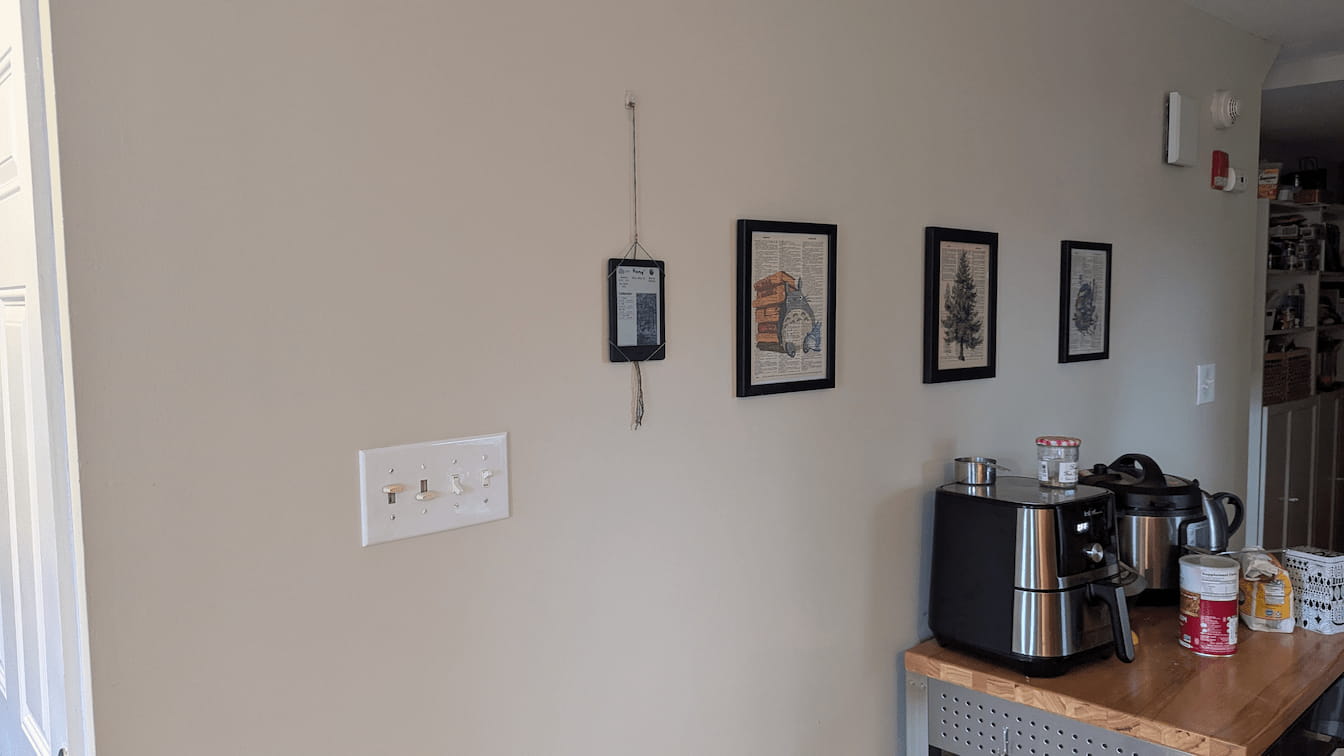
Ever since I created my Kindle Display, it has become my morning ritual to stumble bleary eyed into the kitchen, put the kettle on, and then take the few steps over to my Display, to peer into it as it hangs steadily from my kitchen wall. I am greeted by whichever delightful photo it has chosen that day at the same time as I am confronted by the day’s calendar events, most of which I had shoved out of my mind the moment after I had written them down.
Before I leave the house, as I’m making sure I have my wallet and my keys, I step over to the Display again, to check the weather and to make sure I haven’t forgotten an upcoming appointment. If the Display tells me it is “Seattley” or that there’s a high chance of “Sky Water”, I’ll make sure to grab my raincoat as I head out the door.
I’ve become so used to the Display’s presence that, during a week when it was removed from the kitchen for repair, I became adrift. I found myself walking over to where it used to hang just to stare in surprise at the blank patch of wall before me. During that week I was late to several meetings, and one day even found myself caught out by the rain without a jacket, having not checked the weather earlier that morning. It was such a relief when I finally fixed the Display and put it back to its rightful place.
All of the information that lives in the Display is of course present on my phone – indeed, the weather is even on my lock screen – but once I had given that information a fixed physical presence in the world, so too did my brain fix itself stubbornly in routine, refusing to look for that information elsewhere. This may sound like a bad thing, but in fact it is wonderful.
With the Display, I now always know where my calendar and forecast live. They are no longer buzzing gnats of data, but have instead been transformed into fixtures of our apartment, just like our kitchen knives or our shoe rack.
Now that I have the Display, I couldn’t imagine living without it, and am actively thinking about what other parts of my digital life I could change in this way.
I’m sure some of my readers are laughing at this point. Isn’t this sort of thing, calendars hanging on walls, exactly what we invented smart phones to get away from? Isn’t it better to have everything in your pocket, viewable at a moment’s notice? Surely the only thing better would be some sort of subdermal implant!
To you I would say: I am overwhelmed by my smartphone. I open it to check my calendar, and minutes later I emerge, having just read three emails, a text from my mother-in-law, and a Bluesky thread about the latest horror from the presidency. I never even opened the calendar app, and now, with a fresh dose of stress chemicals flooding my body, I have in fact forgotten why I even took out my phone in the first place.
(which I was also born with?)
Before you think I just lack discipline, I don’t think I’m the only person suffering from an adversarial relationship with their smartphone. You can see it with the digital nostalgia movement that’s in full swing right now. Whether it be to regain their attention or their privacy, people are switching back to DVDs and vinyl, building their own personal cyberdecks, and even using wired earbuds again.
I propose that building more calm physical representations of our digital spaces is another way to regain that control, and a healthier way to interact with technology at that. Our bodies were made to touch the world around us, to feel the breeze, to spot animals in the brush, to, you know, touch grass. Not to stare at an LED screen three inches from our face and to jam our finger against it for hours at at time.
Smartphones themselves are physical things, but they are also somehow ethereal, almost more like extensions of our bodies than an external object. We carry them around with us everywhere, and while we do touch them with our hands, we mostly interact with them using our eyes and ears, absorbing the information that is broadcast to us by them. Furthermore, these appendages aren’t under our full control. Companies like Apple and Google have equal ownership over them, and constantly tamper with them when we’re not looking.
I don’t expect physical objects to move out from under me. If I set a book down, I don’t expect it to suddenly change appearance and move across the room, except by intervention of a meddlesome housemate, and then at least I know who to yell at. There’s a security in making a digital object more physical and tied to one space, knowing that it won’t change unless I change it.
You might be wondering, if I like tangibility so much, why I don’t ditch digital technology entirely? I should just go out and buy a paper calendar and throw my phone into the sea. But, despite the impression I may be giving in this article, I still love computers!
The Display’s calendar is more helpful to me than a paper one, as it allows Paige and I to update it from anywhere, using our phones. There’s no way I’d remember to update a paper calendar with appointments I made earlier in the day. I benefit from being able to commit them to digital memory immediately. This also means that I can, occasionally, read the calendar while I’m out and about, which is especially helpful if Paige has made changes to it herself. So in these ways, I think the Display is a nice marriage of the digital and physical, taking the best traits of each.
My NFC Sculptures are another way that I’ve been experimenting with making the digital physical. It’s true that my NFC tea timer isn’t much of an improvement over the centuries old mechanical egg timer, but given that the alarm is set on my phone, which lives in my pocket, it allows me to hear it even if I have left the kitchen. On the downside, it means I cannot set a timer without my phone. But on the upside again, I find my tea timer much more whimsical and satisfying than a store bought one, because I made it myself. Tradeoffs!
I’m not sure where I’m going to take this idea next. I would love to add a train schedule calendar to the Display, but SEPTA is so unreliable these days that I think the illusion of arrival times would hurt more than help. Until I have a bigger idea, I think I might make myself some of the NFC Album Cards that I gave as birthday presents as friends.
If you have any examples of this sort of thing in your own life, please share them!